Metatopia 2026
By Alex White
- 30 minutes read - 6182 wordsThe order of these reports is the same order that I played the games in. The quote at the start is the blurb of the game which we saw when signing up for them. Where I can, I've provided links to website and social accounts so you can follow up with people whose work piques your interest.
The Wolves’ Age
By Paul Stefko
Website: https://www.patreon.com/collection/303809
Bluesky: https://bsky.app/profile/paulstefko.bsky.social
A mythic space opera/horror RPG. Heroes from humanity's diaspora return to the solar system a millennium after the sun was consumed by a singularity. Inspired by games like Destiny and Mass Effect and films like Alien.
Setup
Mechanically this is a FUDGE game, and we were given a selection of pre-generated characters to choose from, including a robot who was a great diplomat and scientist, a being who was a soldier and baker, a being of shadow who was a great spy, and a being who was a great artist with light. They each had a number of attributes, gifts and flaws, as per FUDGE.
The setting is a future where the sun has been swallowed by a weird singularity which has allowed various dimensions to exist with our own, and denizens of those dimensions called ‘demons’ to enter our own. Some characters have special powers tied to one of the many other dimensions.
For a thousand years Earth has been isolated, but now explorers from the diaspora of Earth are coming to seek knowledge and fortune.
We were playing an adventure where our group were coming to investigate strange signals from a moon in a remote part of the solar system. A 500m high statue of green crystal in the midst of a sea of dark crystals, and with a monastery of people who want to ‘free the souls within’. We were not sure that was in the best interest of the souls.
Core Game Loop
It ran as a traditional RPG, with our party travelling around, talking with people, using our skills to obtain information or gain access to things. During the game we split our party a little bit, so one team used explosives to gain access to the interior of the statue, while the others took advantage of a mystical opening which appeared. We all met inside with the person who had been sucked into the statue earlier.
Details
This was a two-hour play-test and we didn’t get any further in the adventure than that. The GM wanted to know what we thought of the setting and whether we had freedom to make up details within that setting. The player of the spy had chosen for their character a bronze medallion or wearable item of some form, and during the game decided that there was a relief face on the bronze which was the same as one of the faces on the statue, and that gave magical entrance to the inside. Players were also quite free to push the post-human nature of the character descriptions as far as they wanted to.
My Thoughts
Essentially it was mechanically a FUDGE game, and the distinctive part was the far-future setting with elements of sci-fi which tinged toward magic (I’m leaning on the Arthur C Clarke description here). In the part of the game we saw we didn’t engage with any of the key questions about what had happened to the earth, what caused the singularity, what is happening with these various dimensions and ‘demons’. Ideally a playtest adventure would enable the players to engage directly with the very biggest themes of the game in my opinion. Time limits what you can do in a short session, and I hope the designer received useful enough feedback. The setting didn’t really intrigue me, and I can’t see it as a game that I’d follow up or play, but that’s just a personal thing.
They Were Here Long Before Us
By Noa
Website: https://noa.land
Bluesky: https://bsky.app/profile/nnoa.bsky.social
A weird fiction solo mapmaking RPG/wander game. Explore the neighborhood, looking for the traces of the ancient past apocalypse, and make your plan for the next one.
Setup
This is a solo game, and there were four of us playing independently, and reporting back together at the end. We were each given a booklet written in a diegetic fashion - notes from an elderly person containing hand-drawn shapes which represent sigils left by people long ago, from the last time the Others came. Each sigil had a name and an explanation for it. The Others are coming again and we must be prepared…
Core Game Loop
There are two parts of the game. The first part is wandering around, drawing a map and locating the sigils on it where you see the shapes in your book (or things that look like those shapes). These include isosceles triangles, curves, frames; ten in all, with space for you to add a few of your own. Some people walked around outside, I walked around the hotel inside, some people did a bit of both.
The second part of the game was where I sat down, looked at the map I had drawn, and the meaning of the various sigils, and then started drawing inferences between them - which ones were close to which other ones? How did I want to relate them?
Details
I wasn’t so much of a fan of the walking around and drawing the map part of the game, but I really enjoyed pulling together the relationships between the sigils and starting to build a story out of them. There are some questions in the booklet and answering those - what assets do you have, what dangers are there, what will you do and so forth - helps bring some focus to the overall story I was creating. The last set of questions were much more directive in terms of fighting the Others (and our stories didn’t necessarily fit those - we suggested that some open ended questions might work better there)
In my story ‘graft’ was next to the ‘sinkhole’ from which the Others had emerged in years past. It was the works of our people in that long ago time which had first let the Others in! (Had they delved too deeply, perhaps?) The ‘graves’ of those who had fought against the Others was near to a sigil that represented a sundering of the world — the people of that age who had fought and died led to the world being broken. ‘Starlight’ drove away the Others and a ‘memory’ sigil tells me we danced to remember that. Remembrance is important. When the Others arrived they went to a ‘cache’ which enabled them to live in our world. I’m going to the cache so that I can survive in their world, and then I’m going to the sinkhole to take the dance to them, so that they might understand us, and there would be war no more.
My Thoughts
This isn’t the kind of game that I’d normally go for, but I found that the process of mapping and building relationships between sigils was very good for stirring creative thoughts in this occasion. It was lovely to see that each one of the players had created very different maps and even more distinct stories about what had been learned from the past and what we must do in the future.
A creative game which includes both the physicality of movement and the creativity of story building within the overarching constraints of the game.
To Sever The Star Roads
By Lyme
Website: https://brackish-draught.bearblog.dev/
Bluesky: https://bsky.app/profile/lymerpg.bsky.social
A tense, grimdark, spreadsheet-core game of spaceship maintenance, space battles, insider commodities trading, and demonology. Play the crew of a jury-rigged raiding ship, destroying interplanetary trade routes to free your homeland at the cost of your souls. Combines Chain×Link dice mechanics for voyages with loosely blackjackesque card mechanics for encounters
Setup
This is a science-fantasy game with spaceships and a stock market which is run by demons. Years of your life are the currency that you spend, bid with and pay with. If you run out of years of life, you are done.
The characters are commerce raiders, aiming to disrupt interplanetary commerce in order to make a killing on the stock market via insider trading.
A deck of cards is separated into a pile of face cards and four piles according to each suit. The suit piles are placed in a circular pattern between four systems, and each suit represents one of the trade goods (antimatter, sacrifices, homunculi, and cybernetics). Face cards are warships that get introduced into the decks as a result of your raiding activity.
Your spaceship is falling apart at the seams and requires constant maintenance while travelling. Space combat is fast and deadly. Travel is slow and arduous.
We each have a very simple character sheet with a commodity we have worked with before, a skill that allows us to tweak some game rules to our advantage, and a ship specialty that indicates what we are good at repairing.
Core Game Loop
First you travel to a star road, attempting to maintain your ship to keep it in good condition.
Then you bid on the markets - wagering years of your life, and with a leverage multiplier that increases as time goes on.
Then you attack a ship to destroy it or board it.
Resolve the impact on the markets, and work out your profit or loss.
Continue to bid and attack and resolve until you think there is too much risk of an attack
Finally travel to another location, either to resupply at home or to raid another area.
Details
There are a set of tables laid out in front of us that show four elements of life support, four elements of engineering and three elements of weapon systems. While travelling we take it in turns to roll a d10 to see whether we can assign it to one of the elements to protect it from degrading. If your roll is less than or equal to any previous role, then there is a problem and one element of the ship randomly degrades.
Degraded life support will cost you years of your life. Degraded weapon systems are less likely to work properly. Degraded engineering can impact your travel time or ability to flee, or cost you years of life.
You can also use some of the dice to protect your health or your skill rather than maintain the ship.
Bidding on the market is easy at the start of the game, as all the ships on one road start with the same cargo, so we knew we were targeting cybernetics. We all bid all of our years of life each time! Attacking a ship has a base 90% chance of success. Successfully boarding gives a much greater reward but requires a 60% comms task followed by a 60% boarding action by our marine. We quickly fell into the routine of sending the marine in, he failed and was captured, we destroyed the ship and then thawed out another clone of a marine who didn’t know what had happened (the marine player took it in good spirit)
To see how the markets respond a d6 is rolled six times. After each roll anyone can decide to cash out or continue. Each d6 result increases the payout by 1%, except that if you have a duplicate (e.g. a 5 followed by a 5) it goes down instead. If you get three the same in a row it is worse. We were quite comfortable allowing the bidding to go up and up and did well out of it each time.
Two cards from each deck are moved onto the next deck round and shuffled in, as the trade roads get a bit more muddled up (and giving us less certainty about what we want to bid on). For every successful attack a warship (face card) is added to a deck, increasing the chance of a very bad encounter for us.
We played through three attacks and a couple of sets of travel.
My Thoughts
I love the idea of commerce raiding, the patterns of ships travelling between the worlds, insider trading and all of that. It seems odd to be doing in years of life, but that is just part of the science-fantasy of the setting.
In practice, maintaining the ship was easy (and got easier as the voyage continued, which felt like it was going the wrong way round!) We had quite a lot of discussion with the designer about this, wondering what might be done in order to increase the sense of risk and frustration of managing a ship that is falling apart.
There isn’t much of a role-playing element in the game in that characters don’t have personality traits or much reason to talk in character with one another apart from what players choose to bring into the game. I almost wonder whether this would work particularly well as a board game in that respect? I could absolutely see breaking out the “Sever the Star Roads” board game and setting it up as a board game of interstellar raiding and commerce manipulation!
The Fallen Covenants: A Return Home
Matthew Wander, A Sky Full of Ghosts
Website: https://fallencovenants.com
An original modern supernatural tabletop RPG from The Sky is Full of Ghosts Media, built on Resonance Edge, a brand-new resolution system. You play human mages caught in an endless war between fallen angels and demons. You don't choose a side in their war; you hold the line against both, as peacekeepers and investigators working where factions collide and the supernatural bleeds into ordinary life. The horror is real, but not hopeless: you are desperate defenders, not doomed victims. One set of rules covers investigation, social conflict, combat and the supernatural, and every roll moves the story forward, whether you succeed, partly succeed or fail. In this session you'll play A Return Home, the first scenario for the system. It's a playtest, so expect rough edges, and expect to be asked what worked and what didn't. New players welcome.
Setup
This is a big crunchy game with long (4 page) character sheets that are filled with information. It’s the kind of game designed for campaign play which needs a clear focus for a 2 hour playtest slot, and the designer wisely chose to focus on an element that they wanted to bring into the combat system, so we played through two combats - the first one with the combat system as-is, so that we all had a baseline expectation of how things worked, and then a second combat with an additional consequence die’ included.
There were nicely presented dossiers in folders for each of the characters.
Core Game Loop
The basic system of the game is that your character has scores of 1-5 in various attributes (I think it was about 10 attributes) and scores in a few skills in a large list. I don’t have my character sheet to check, but I think I had about 30 skills, of which about 8 had 1 to 3 pips associated with them. In order to accomplish something with a skill you add your attribute to your skill and then roll five ‘fate dice’ (marked +, -, and blank) which will modify your final score by between -5 to +5 depending on how well you roll. In opposed checks in combat the number by which you beat the opponent is significant - beating them by more will do more damage to them. Armour can reduce damage (but 1 point will always get through)
Initiative is a skill which is rolled at the start of a combat, and it then proceeds in initiative order highest to lowest. It remains static for all the rounds of the combat.
Details
Our characters were fighting dog-men, and the first fight went quite smoothly. A couple of the dog-men could spent a point to shrug off what would have been a killing blow using a mechanism the characters also had, but it did make the fight a little bit frustrating at points. We felt it would be better reserved for major villains rather than the run-of-the-mill things we were fighting here.
In the second fight we also rolled the consequence die for each of our attacks. Whether our attack was successful or not, we add the value of the d12 consequence die to the ‘effect number’ of our attack and looked up a column on a table, If the total was high there was a set of increasingly good options you could choose to apply to your attack (like ‘ignore half armour’ or ‘ignore all armour’) and if the total was low you can choose from something like ‘fear’ or ‘damage friend’ or 'lose weapon'.
My Thoughts
The idea of the ‘consequence die’ was interesting in the range of choices it provided to the player, but it added to the handling overhead of every attack because you had to roll your attack and then find out what the difference was between the defenders roll, and then add on your d12 value and then look up in a table, and then make a choice from a range of options. With 4 or more PCs that is quite a lot of additional overhead.
Also (and I’m not sure here) you could end up with a roll that hits and has an effect, but if you roll a 1 or 2 on the consequence die might end up with a bad side effect rather than (or in addition to?) damaging the opponent.
Now this is clearly a rules-rich game, and that might not be a worry for the main target audience. For me it wasn’t quite worth the extra handling which it introduced into the system.
Desperation
By Jason Morningstar
Website: https://www.patreon.com/cw/bullypulpitgames
Bluesky: https://bsky.app/profile/jmstar.bsky.social
Join me to playtest some new Desperation games. Previous experience not necessary. We will try out some new stuff, probably playing a couple of different games.
Setup
Desperation is a card game from Jason that has been around for quite some time. There is an SRD and several people have done their own games based on the mechanics (including me!)
On this occasion I was testing a set called Red Ash, which was about a real mining disaster at Red Ash Mine on 18 March 1905 which killed 13 miners and 11 attempted rescuers. The people cards had photographs of and information related to actual people who died in that disaster, so it requested that we treat the people represented with respect and empathy.
Core Game Loop
It is the classic Desperation game, where you draw cards and start laying down locations, then people in those locations, and then start drawing event cards - Act 1 where people are working underground, Act 2 when an explosion seals them in, and finally Act 3 when things are getting very desperate 24 hours later.
Details
There are three groups of people among the miners - the white American miners, the Black American miners, and the Eastern European miners. The owners at the time were happy to play off each group against each other. There are old miners, young miners, brothers, and miners with young families outside. This is important because in Act 1 the event cards are distinct for each people group, reinforcing the different attitudes and values within each group.
Once Act 2 kicks off with the explosion that brings down the entry to the mine, any of the cards can be assigned to any person — the scale of the disaster has put everyone on the same, desperate, level.
A feature that is unique to this playset is that in Acts 2 and 3 the mine continues to collapse. Sometimes a card will say that a whole location collapses and is buried, killing all people in that location. This increases the sense of claustrophobia and desperation during the game. Knowing that these represent real people some of the cards really strike home while you are reading them, thinking about how despair can lead some people to death and others to hope.
There are two possible ending cards, one of which is randomly chosen. One leads to rescue. The other replicates real life when the rescue team and everyone still in the mines die.
My Thoughts
It shouldn’t be a surprise that the originator of the Desperation game can produce another really heartbreaking edition. It leaves me thinking not just about the people pictured from this mine disaster but also from all those other mine disasters over the years. It perhaps isn’t a game for the claustrophobic, but I’d like to replay the game in a room where I can turn off the lights and play by torchlight for Acts 2 and 3.
Hosts
By Morganite Games
Bluesky: https://bsky.app/profile/morganitegames.bsky.social
A collaborative storytelling game where players work together to prevent an Old One from breaking into our reality. Players act cooperatively until insanity forces them to turn on each other. Using nothing but a deck of cards, tell a story of cosmic horror, investigation, and inevitable betrayal.
Setup
A deck of 52 playing cards plus jokers is shuffled and four cards are laid out on the table to reflect the four aspects of the Old One that have to be discovered.
Each player is a ‘Host’— someone touched by one of the Old Ones’ powers. They are given a randomly drawn playing card that gives them protection against that suit, and a special power associated with that suit.
During the game you accumulate ‘stress’ and every time that exceeds 21 you gain ‘horror’. If you get to three ‘horror’ cards then you switch sides from Host to Kin, and start working against your former comrades.
Core Game Loop
Each turn you set up a Location, an Objective, an Opposition, and a Challenge. (going round the table so everyone has a say in filling this out). Once three challenges have been completed in this Location the objective is completed and the Old One card is taken by the player who was successful. Each challenge has a card suit that tells you whether it is a physical, mental, social, or magical challenge. If the key card suit matches your own protective card, you can automatically complete the challenge at the cost of one stress. Otherwise you draw cards from the deck - if you match the key card suit then you are successful, and discard that card. If not you add it to your stress and continue drawing. You can abandon if it is too risky.
There is an insanity card suit which doubles the value of any stress card with a matching suit, and that can easily make your stress go bust. Very easily!
When you reach three horror cards you become Kin, you are playing by different rules with different special abilities and you are attempting to frustrate the other hosts - including duelling them to steal their cards.
Details
It can be complicated to remember which of your cards are your protective card, which are your stress cards, which are your horror cards, and which are your captured Old One secret cards because they are all just cards from the deck! We decided upon a pattern for laying them out that worked for us, and suggested that the designer might benefit from including some guidance about that in the rules.
The game was going fairly smoothly for the first three sets of secrets, but in the last secret first one and then another, then the remaining characters quickly toppled into being Kin - abandoning the original plan and then fighting amongst each other until there was only one left. That last stage would have happened even more quickly if it hadn’t been that two of the other players had heart powers which allowed them to remove someone else’s stress at the cost of gaining stress themselves… and they bounced back and forth several times acquiring stress to bail each other out until they had both ended up in a situation where they hadn’t tipped over into complete horror and became a kin.
My Thoughts
We wondered if the insanity card had been introduced because the Hosts were winning too often, and it was! Now I’m wondering whether they see any Host wins, because the doubling effect of one of the stress suits is very strong and hard to deal with.
There is lots of improv opportunity in the game, both from setting the objectives, deciding on challenges and in our case describing the impact of horrors and what it looked like with our seemingly inevitable fall into being kin!
The game is pretty much done, and I imagine it will be available soon. It’s an excellent little horror one-shot game.
The World's Problems
By Emily Care Boss, Green and Black Games
- website: http://www.blackgreengames.com
- Tumblr: https://www.tumblr.com/keirgreeneyes
A game of espionage and bureaucracy. Play highly skilled field intelligence agents, called Wreckers, on dangerous missions, and the water-cooler corner machinations which put them into play. An original system influenced by the Powered by the Apocalypse engine. Character focused, multi-role, GM-ful play.
Setup
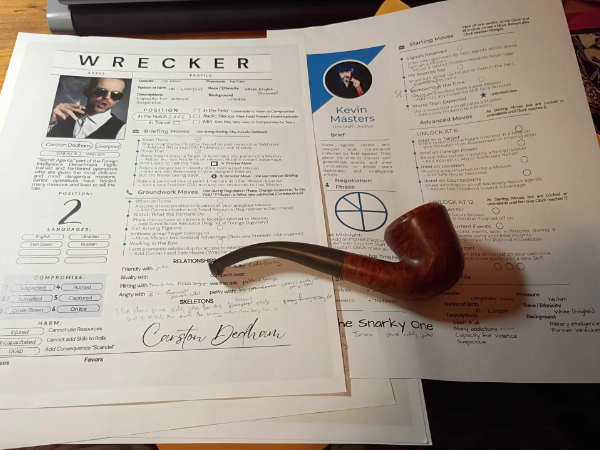
I playtested this last year and it remains one of my favourite game concepts. This is a 1970’s set game of espionage very much in the LeCarré mode rather than the James Bond mode. As before the delightful level of period and character detail drew me into the game and left me wanting to play more (much more!)
In a two hour session we didn’t have time to do much more than character generation and in this case get into the mission briefing (last year had been some office shenanigans prior to the start of the mission briefing).
As before we each played a Wrecker (the agent who goes into the field) and an Analyst (the one who is working hard in the office). Once again I played Carston Dedham, my disreputable ex-jewel thief, and this time I also played an analyst Kevin Masters who was an (unusually) retired ex-wrecker and pipe smoking addict of tobacco, gambling at cards, and much else.
Core Game Loop
The overall game has a broad division between office work to set up missions and get permissions lined up for them, and actually performing the missions. The time restrictions mean that we don't get to test that this time though.
Instead we did character creation again (the game was new to the three other players) including building of relationships and establishing their characters a little.
Then we moved into the process for working out how difficult our two operations were going to be - the Ugandan extraction of British embassy staff, and working out whether the wife of an ex-KGB officer was a potential asset or potential honeytrap for the Vienna station chief.
We had an operations chart with lots of potential challenges, and Wreckers and Analysts took it in turns to use their 'moves' to identify which challenges would apply to us, and how difficult those challenges would be.
Details
We had fun setting up our relationships, and this is a little relationship map I drew up to help keep track of things.
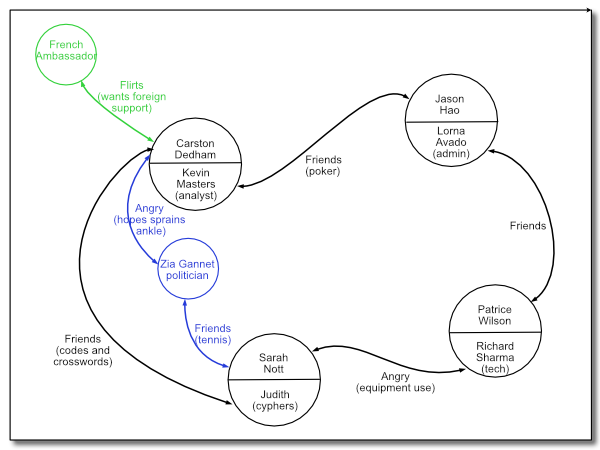
Carston had a nice scene with his friend the analyst Julia (cyphers) where they were bonding over their love of using codes and cyphers to communicate in plain sight in a pub. The pub was getting a bit rowdy as the footie on the telly was going against them, and Carston decided that he could best keep them out of trouble by inviting Julia into a long snogging session at their table, which she was certainly up for.
On to the real business though!
Challenges can be at a disadvantage (roll 3d6 and use the two lowest), normal (roll 2d6) or at an advantage (roll 3d6 and pick two highest). The player characters use their moves to add challenges to the sheet. For instance the wreckers have the move "Been There" which can be used to add two challenges at disadvantage. The number 1 Wrecker, Patrice used that to remember working with a hunter in Uganda some years ago and was able to tell us that we would be facing "difficult terrain" and "armed opposition" IIRC, both at a disadvantage. Julia the cypher expert had decoded some recent messages which suggested that the Vienna job would have the challenges of being in a public place, and with lots of survelliance around. Carston used "Been There" to recall that one of the public places that could be used was more out of the way, upgrading that from a disadvantage challenge to a normal challenge. The techie analyst then decided to provide the junior wrecker for the Vienna mission some video feeds for extra eyes within the rooms, providing some comms and tech resources towards that mission. And so on. A lovely organic feel to it, and players didn't just name the move and say what they added - they described something in character and then filled out the mechanical implications on the sheet.
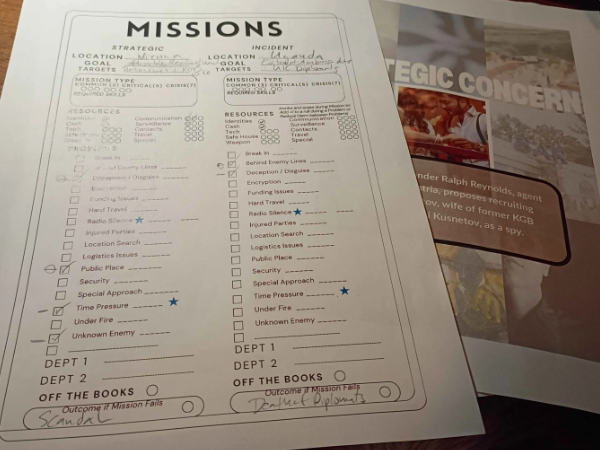
For building up the challenges for the missions, I can't think of a better way I've seen it done in any other system.
My Thoughts
I continue to love every part of this game and I'm going to repeat what I said last year: The somewhat grubby scenarios we found ourselves in. The cleverly drawn analysts who are fun to play and also will be contributing to missions. The complex possibilities of a negotiation phase with all those political moving parts. I can’t wait to play it again in more detail.
I love the concept of the wreckers and analysts brainstorming together to identify the problems on each of the missions. It felt natural and bolstered our characters while also ensuring that each mission had distinct and appropriate flavour.
A Panel! Crafting Small, Discrete Experiences
Hosted by Jason Morningstar, with Jess Dieterle, Tim Hutchings, and Alex White
How short can a game be? How focused can a game be? During this panel, folks who are pushing the edges of these questions will share their ideas, and the games they love. We will be talking about tabletop role playing games and LARPs that push thematic and physical limits to make things compact and meaningful in surprisingly small packages. Can a LARP be ten minutes long (yes)? Can you make a tabletop game about having a migraine (again, yes)? Join us not only to learn about weird games, but also to discuss the advantages of keeping it short, simple, and to the point.
Yes, I was invited to be on a panel! It was lovely to be with such experienced designers talking about different kind of small focussed games. Some are tightly focussed because of the word limit or page limit that they are written to. Others (such as many of my games) are small in terms of the focus that they have on one specific thing - in my case women spies in WW2 France, Tail-Gunners in bomber command during WW2, and soon one single day in WW1 when the Christmas Truce broke out. Others might be designed to be played in a short period of time.
It was great hearing the other panellists talk about their games and the principles they use. There were also some really interesting questions (and plenty of time had been left for questions). The whole panel will hopefully appear at some point on the RPG Panelcast. I particularly liked questions which were highlighting the value of short play time for educational play and questions related to killing your darlings to make things smaller - no, smaller than that!
Road to Romance
By Alex White, Plane Sailing Games
Kevin Kulp is testing the rules for Alex White's Road to Romance - a game of telling compelling romantic stories with a happy ever after at the end. Each person plays the protagonist of their story, the paramour of the person to their right, and the Trouble of the person to their left. The game’s author will watch but not participate.
Details
You can find other information about Road to Romance on this site. I ran one standard game of Road to Romance (which included a paranormal regency romance with a Royal Navy officer torn between a siren on one side and a vampire on the other; a cosy wild west where a newcomer in town falls in love with the sheriff against the will of the mayors daughter who had an eye on him; a German gun-runner in WW2 France who is abandoning his wife to hook up with a sexy French resistance woman). More interesting from my point of view is watching from the sidelines while Kevin ran a game with a Wrestling Rom-Com with two enemies who fell in love while competing against each other, two competing writers falling in love on a writers retreat, a Victorian Gothic in which clavicles feature highly, and a paranormal wartime romance where a vampire in the american civil war fell in love with an artist who wants to paint him, but he can't come out in the light.
My Thoughts
Watching the setup of the game it solidified my feeling that there are some serious problems in the setup for playing the game at the moment. Once people get going, things fall into place, but understanding what the setup looks like and what their roles are going to be has quite a lot of sticking points.
One of the things which is straightforward to fix is a change in terminology. The fact that Protagonist and Paramour both start with a P and have a similar number of syllables was clearly causing some mix-ups. I think I'll probably rename Paramour to Lover, which should help resolve that.
The other thing that I want to playtest next is a setup where we create the protagonist, lover, and trouble for player 1, then do the same for player 2 and on again for player 3 etc. Once each of the collections of characters are set up then each of the players pass their Trouble to the player on their left and the Lover of their story to their player on their right. Hopefully this will help keep everything straight in everyone's minds. This will need some quite major changes to the way the instruction cards work though, and that will take a bit of thinking about!
Road to Romance duets
By Alex White, Plane Sailing Games
We will be testing the rules for a duet version of Road to Romance - a game of telling compelling romantic stories with a happy ever after at the end. People will play in pairs. Spice level will be agreed in advance and safety tools used.
Details
I ran this playtest twice, in each case with three pairs of people telling duet stories together. One member of the pair playing the Protagonist, the other member of the pair playing both the Paramour and the Trouble. It puts more work on that second player who has to manage two roles. In both instances there were people who had never played Road to Romance before at all, but they enjoyed the experience and where really glad that they took a risk on it. Stories included a Gothic romance where someone married his sister and killed his other sister, a sci-fi paranormal romance reminiscent of The Day the Earth Stood Still, a Sports Romance with iceskaters, a fantasy rom-com, and an enemies to lovers story between a sci-fi rebel and the local imperial commander.
Particularly interesting are the comments by experienced designers that the duet version of the game might be the best 'primary' version of the game. I can see that it is easier to get a pair of like-minded people together than a group, and that as this kind of pairs game it would fit nicely on the shelves of many bookstores and not just games stores.
My Thoughts
I hadn't expected to find such a curveball as making the duet mode the default for the game! There are several potential ramifications of that (in particular making the role of the Lover a little richer). I'm not putting my ideas down here just so I can get this article out quickly. Once I've had a chance to discuss more with the people behind the thought-provoking comment and thought through what I want to try out next, I'll write up a proper design blog about what my next steps are.
Conclusion
As always Metatopia has been an absolute delight. It is wonderful meeting old and new friends, enthusiastic designers and playtesters, both around the game tables and in the many conversations during the day and late into the night. I'm repeating myself from earlier reports, but smart people, talking passionately about the subjects they love is very invigorating!
All credit to Avonelle, Vinney and their friends at Double Exposure who make it all possible. Find out more about what they do here: https://dexposure.com/home.html
Header photo from the Crafting Small, Discrete Experiences panel courtesy of Camilla Zamboni