Review - Microscope
By Alex White
- 9 minutes read - 1794 wordsLast Sunday I played Microscope by Ben Robbins with Camilla Zamboni and Tristan Zimmerman. I’ve known about Microscope for years, and always wanted to have a go, but had never had the opportunity until now.We played online, using Discord for video and chat, and a free Miro subscription to manage the cards used in the game.
The Basics
At the outset you agree together the very high level basics of the story you want to tell. You can also set a ‘palette’ of concepts that you would like to see included or that you would like to ban from the game entirely. This helps provide unique twists to each game.
The core of the game uses index cards to represent Periods, Events, and Scenes. These are zooming in to more and more detailed views of the story (I think of this being the ‘microscope’ of the title. Looking with increasing magnification). These are nested within one another, so Periods are the highest level, reflecting major events on the timeline. Within a Period you can have any number of Events, which are significant things that are happening within that period. Within each Event you can have one or more scenes, which is where the roleplaying happens as you step into characters who are part of those formative moments.
Each of the cards is given a ‘tone’ which can be either light or dark. This gives everyone an idea of what that little bit of history is like for those living through it.
The other basic thing is that you don’t have to move through time telling a linear story... you can freely jump back and forth, in and out along the timeline to discover more about what you find interesting.
Playing the Game
You start by agreeing what the Periods at the start and end of your game are going to be, jot these down on vertical cards and place them at the left and right sides of your play space.
You then play a number of rounds. In each round a different person takes on the role of the ‘lens’. This person gets to define a focus for the round so that all the actions taken are thematically linked--say to a place, an organisation, or a person. The ‘lens’ starts by creating a couple of linked things (a Period and then an Event within it, or an Event and a Scene within it), and then everyone else follows suit. You don’t need to follow within the same period... even if the focus is a particular individual you can zoom into the past to see what led to them, or the future to see how people remember them!
Events are index cards which are placed landscape under a period, and Scenes are index cards which are placed portrait and nested under an event.
As you play, you can move the cards around as you insert new elements into the timeline.
There is no fixed end to the game - you can just stop whenever you feel that you’ve told enough of a story. If you run out of time in one session you can just gather the cards up in timeline order and lay them out again the next time you play, which is neat.
Why I like this game
I like this game because of it’s breathtaking scope. You could tell literally any kind of story from fantasy to sci-fi. It would be easy to take in horror stories along the way. The flexibility that it affords is remarkable.
Mechanically the use of index cards placed in portrait or landscape format are such a clever and simple way of laying out history while keeping track of everything.
While collaborative, I appreciate that the rules mean that on any individual’s turn what happens is entirely up to them. Nobody is allowed to give them suggestions (even if they ask for it!) This seems strict, but it does give plenty of space for quieter people to explore what interests them even in the face of wildly creative or expressive fellow players!
Where can you find the game
Look it up on the Lame Mage website here: https://www.lamemage.com/microscope/
Follow Ben Robbins on Bluesky here: https://bsky.app/profile/lamemage.com
Would you like to see a story?
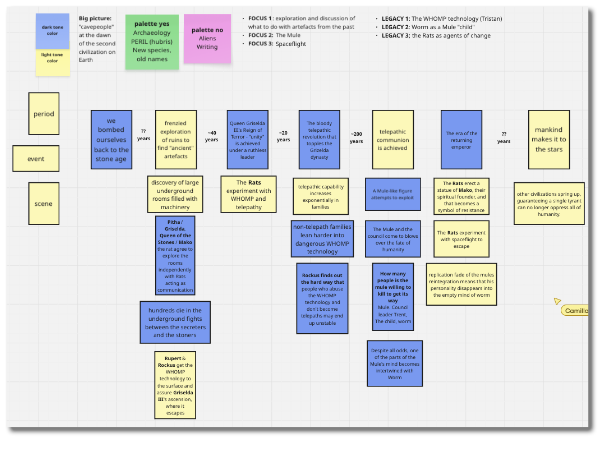
We decided that we wanted to tell a story that starts with 'cavepeople' at the dawn of a second civilisation on the earth. Our starting period is We bombed ourselves back to the stone age (dark) and our ending period was Mankind makes it to the stars (light).
Our palette of things we wanted to include was Archaeology, Peril from hubris, Old names used for new animals.
Our palette of things we wanted to exclude was influenced a little by thinking about what weird twist might Ursula K LeGuin use, so as well as ruling out Aliens, we also ruled out Writing(!)
As part of our setup there is a new Period which is "frenzied exploration of ruins to find ancient artefact" (light), a Period further in the future where "telepathic communion is achieved", and an event under that where "A mule-like figure arises who attempts to exploit the communion"
For our first round the lens is "exploration and discussion of what to do with artefacts from the past"
We have an event under our exploration period which is "Discovery of large underground rooms full of machinery", and then a scene under that with the question "Do groups work together to explore, or do they divide into groups?"
The scene revolves around a discussion between Pitaa, keeper of secrets, and Griselda, queen of the stones. Also present is Mako, leader of the 'rats' who do the deepest delving. Pitaa loves secrets and the power they bring and argues strongly that the groups that she and Griselda represent should work separately to explore, and share useful knowledge as and when it is significant. Pritha is particularly interested in delving into the machines that go Whaaang, and the WHOMP technology. Griselda is opposed to the idea but eventually agrees as long as the Rats keep lines of communication open.
We then had another dark event, as "Hundreds die in the underground fights between Secreters and Stoners". There is a scene which marks the end of that event where Lord Rupert of the Stoners agrees to bring Scientist Rockus of the secreters to crown princess Griselda, the third of her line. Providing the WHOMP technology to her enables her to overthrow her mother, install herself as Queen Griselda III and start a new dynasty. The WHOMP technology escapes into the general population.
A new Period is added, "Queen Griselda III's reign of terror. Unity is achieved under a ruthless leader".
For our second round the lens is "The Mule"
A new Period is added "The bloody telepathic revolution topples the Griselda dynasty" (dark) and under that a (light) event "telepathic capability increases exponentially in families"
An event is added back under Queen Griselda III's reign "The Rats experiment with WHOMP and telepathy" (light)
An event is added after the Mule has arisen "The Mule and the Council come to blows over the fate of humanity" (dark)
Back under the increase of telepathic capability event we added a new (dark) event "non-telepath families lean harder into dangerous WHOMP technology" and we have a scene which answers the question "Does increased use of WHOMP tech for non-telepaths make people unstable?" There is a three way conversation between the now elderly Rockus; a young telepath who is oblivious to his privileges, and a non-telepath who is showing signs of addiction and who wants more and more power from the machines that Rockus controls to give him and his family a future in the future telepathic hegemony. In the end Rockus refuses because the man cannot offer him vast payment, and gets shot for his troubles!
Back with the Mule, we zoom into a (dark) scene with "the Mule and Trent, the leader of the Council, arguing for the future". A small boy, Worm, wanders into the confrontation. The Mule wants to take control of the communion and Trent is fighting against him. Behind him more and more of the council start nodding aliong with the Mule as their minds get captured. Worm somehow wanders in, a little boy with a head empty of thoughts apart from food and toilet humour. His contributions to the debate, such as they are, confuse Trent and the Mule wins the conflict. The question "how many people is the Mule willing to kill to get his way" is answered - thousands. The Mule's consciouness extends out into the telepathic communion, extinguishing minds and taking their place. He is everywhere now.
A new (dark) period is added "The Era of the Returning Emperor" as each time the Mule's current body dies, there is a re-integration from all his fragmented consciousnesses.
Another little dark event is added to the earlier period of the Mule - "despite the odds, one of the parts of the Mule's mind becomes intertwined with the Worm - whose mind was so empty that it coexisted in the background".
For our third round. the lens is "spaceflight"
Within the era of the returning emperor there are several (light) events. "The Rats erect a statue of Mako, their spiritual founder, and that becomes a symbol of resistance to the emperor". Also "The Rats experiment with spaceflight to escape". The final event in that period is "Replication fade happens with the Mule's continual reintegration, which means that his personality disappears into the empty mind of the worm".
A final light event under mankind makes it to the stars is this: "Other civilisations spring up, guaranteeing a single tyrant can no longer oppress all of humanity".
A final dark event is added under the very first part of the timeline "we bombed ourselves back to the Stone Age". This event reveals that "It was the WHOMP technology which had actually been responsible for the destruction of the previous civilisation".
Other notes
Some things that came up in discussion or in scenes that I've not recorded above are nice little details such as without writing information is passed down in oral histories and ballads, before the telepathic gestalt arose.
Horses had feathers and two legs, lions were nice meaty food animals, and so on. Tristan was great at introducing bizarre new creatures which had old names applied to them!
We quite like how the Rats, an apparent underclass, had actually been agents for change and progress throughout this history.
We stopped where we did because we ran out of time and we had each had a go as the lens. Although I don't feel the need to revisit this particular Microscope again, I'd definitely play the game again!